
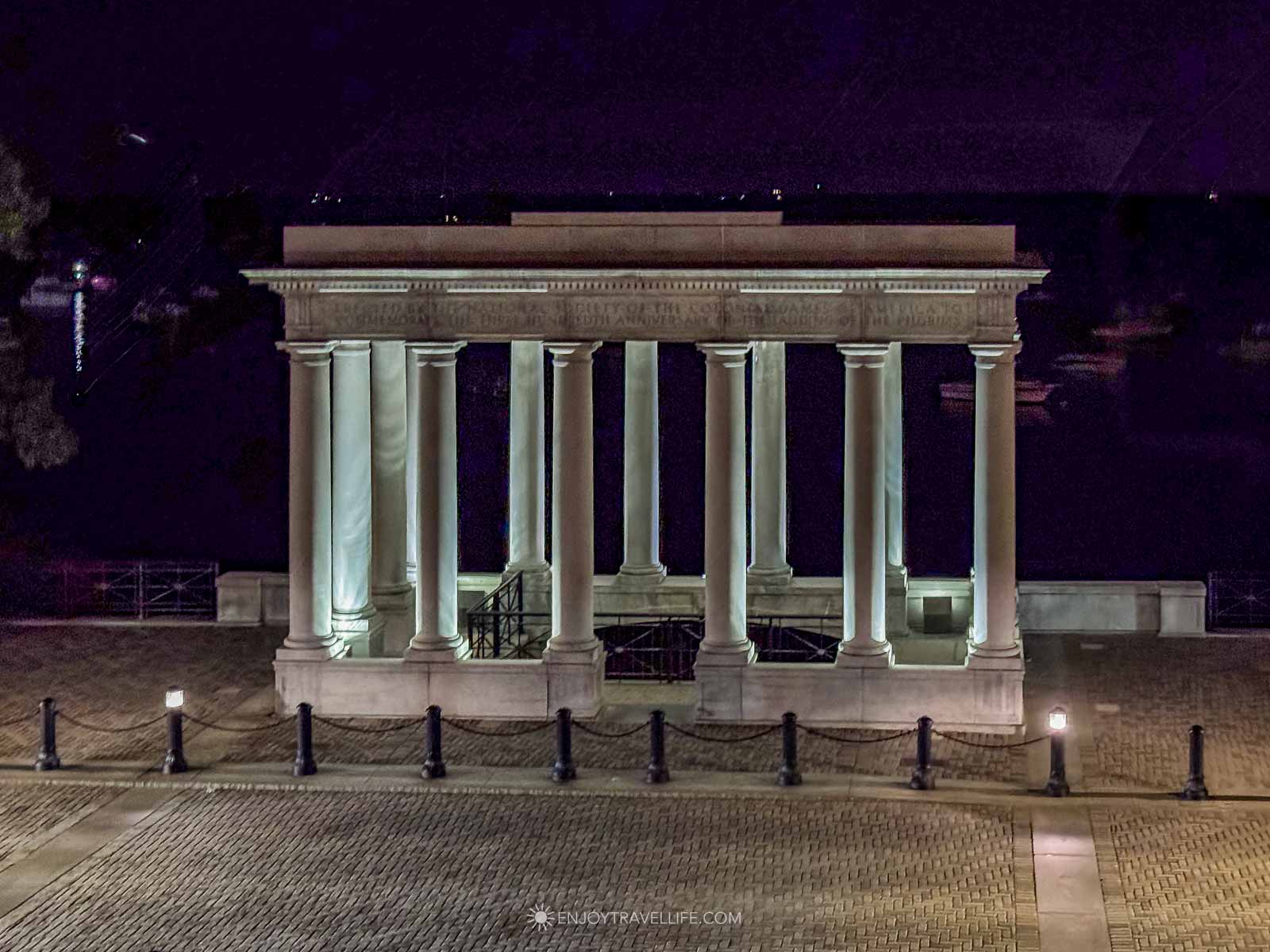

A Plymouth ghost tour picks up where the daytime history leaves off. After dark, the stories move beyond Plymouth Rock and the Pilgrims to shipwrecks, burial grounds, unexplained deaths, and some of the people said to still linger around town in the afterlife.
It’s a fun way to spend an evening in Plymouth, Massachusetts.
Continue reading for my review of the extended Plymouth ghost tour, including what you can expect along the way. I’ve also included a few other options you can compare before you book.
IN THIS ARTICLE
What to Expect on the Plymouth Ghost Tour
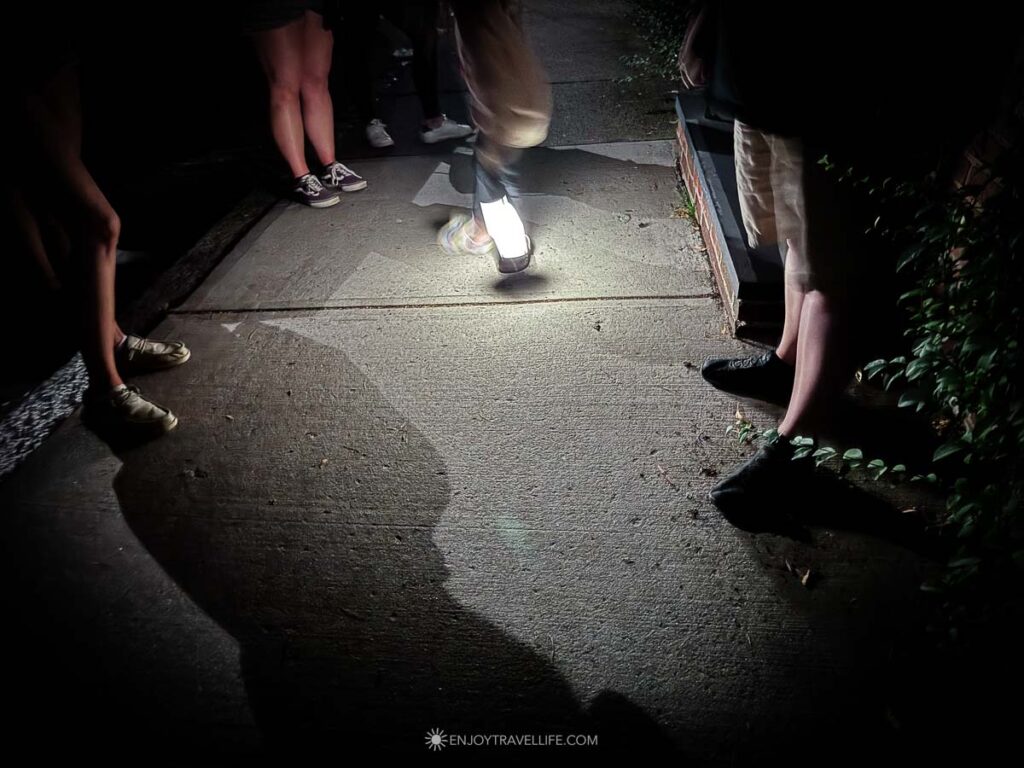
A Plymouth ghost tour starts where the daytime crowds finish. You’ll find several ghost tours to choose from, with different routes, lengths, and experiences. I took the Punishment, Penance, & Plague with US Ghost Adventures and loved it.
This nightly lantern-led walking tour covers about a mile of the town center in roughly an hour. An extended version adds up to four more locations, and you can also rent an EMF (Electromagnetic Fields) detector for a few extra bucks.
The whole tour takes place outdoors, with stops along Plymouth’s historic streets and Burial Hill.
The ticket lists a 9 p.m. finish for the standard tour. If you’d rather stay over than drive home in the dark, the map below shows what’s available across town.
Here’s how my experience went and what you can expect.
Meeting the Lantern at Plymouth Rock
At 7:45 on a Saturday evening in late August, I met our guide at Plymouth Rock, and she was holding a lantern.
The sun was dropping behind the town, and a nearly full moon rose over the water, pink and partly behind the clouds.
The setting couldn’t have been more perfect.
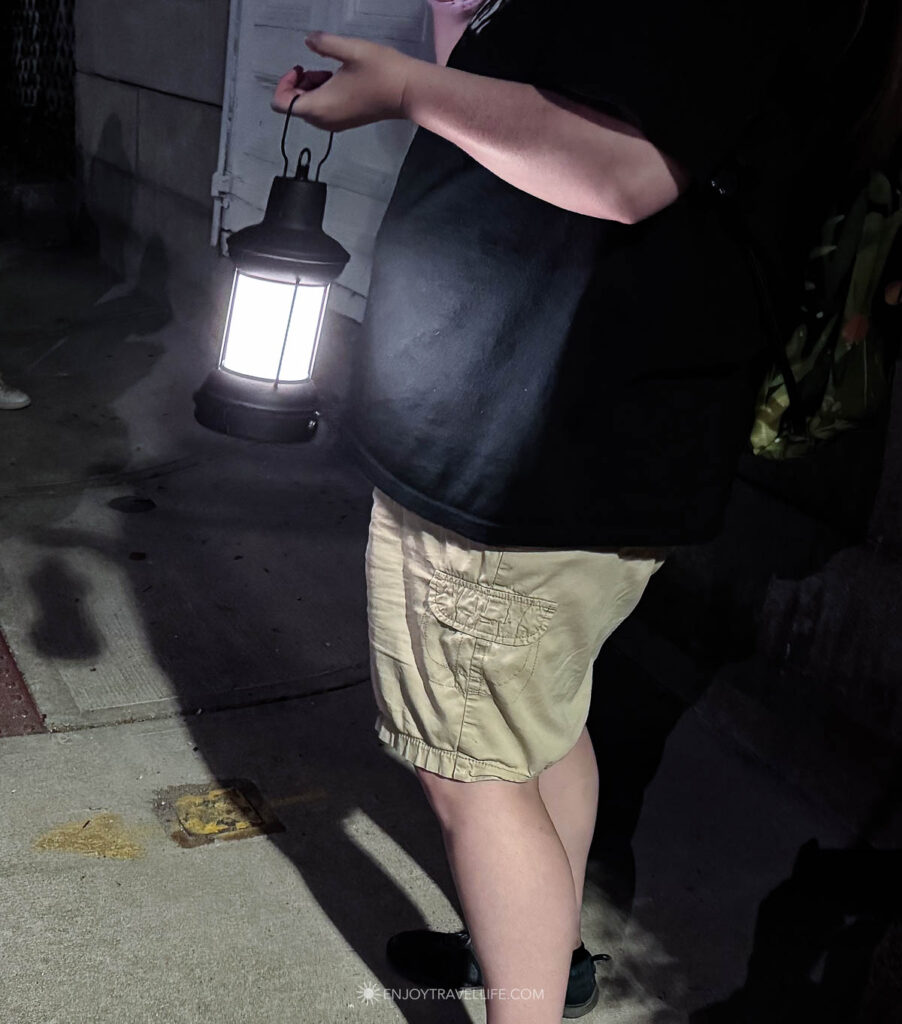
Check-in opens fifteen minutes before the start, so plan to arrive early. Lauren, our guide, was waiting near the portico with her lantern, making the meeting point easy to spot.
There were just six of us that night, including me and a family of five with a young child.
Lauren said the tours can have up to thirty people, although they rarely get that large.
I liked the smaller group. We could hear her easily, ask questions, and gather around each stop without feeling crowded.
Lauren also wasn’t theatrical about the ghost stories.
She was funny and engaging, but she didn’t try to make every story sound spooky. She’d talk about cold spots and doors closing on their own, then point out that electrical wiring can make an EMF meter light up. It encouraged trust.
That balance worked well for me. I let my imagination and my logical brain draw conclusions, and it wasn’t always consistent.
Walking Plymouth After Dark
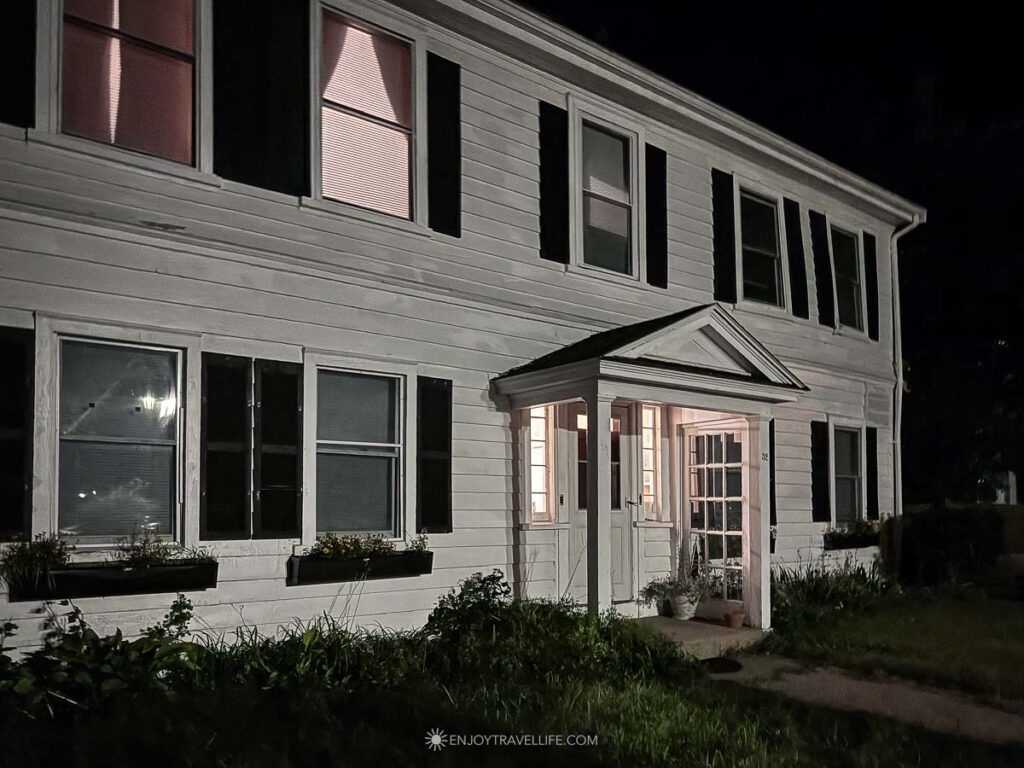
We climbed the steps from Water Street toward Court Street and started walking.
You’ll stand in front of houses and hear what happened inside them, but you won’t go in. Some are private homes, and others are museums closed for the night.
I’m not going to name every stop. Part of the experience is not knowing what’s around the next corner, and the tour is better if you arrive without a map of it.
But the tour does name several locations in advance, including the Trask Museum, Captain Thompson Phillips House, and Burial Hill.
I had an EMF meter with me, added on when I booked. It’s the same handheld gadget you see on ghost-hunting shows. It’s light, simple, and more fun to carry than I expected. It gave me something besides my imagination to pay attention to, especially when my hair stood on end.
Lauren showed us at the start that a nearby phone can make it light up, which is useful to know before you start reading too much into it.
At one stop, mine flashed near the corner of an old porch. I looked around and found an electrical meter about six feet away. Mystery solved…more or less.
As you’d expect on a ghost tour, most of the stories are about people long gone:
A man whose foot was crushed by a horse hauling an ice wagon, and who later died after falling down his own stairs.
A sea captain lost to disease, and his wife weeks behind him.
Renters who couldn’t stay in a house that never troubled the family who owned it.
And “Plymouth’s favorite ghost,” the young Abigail.
Lauren was careful to distinguish what was documented from the stories that had been passed down.
But one of those stories has paperwork behind it.
In the 1730s, a minister named Josiah Cotton owned a house on King Street he could not keep tenants in. The tenants reported growls, cabinets slamming, and lights with no source. By the autumn of 1733, they had all moved out.
Cotton sued them for slander. The court ruled against him in March 1734, stating a belief in ghosts could be neither proved nor disproved, so it was not slanderous. He appealed, lost again, and paid the costs.
I’ve visited Plymouth for years and passed these buildings without giving them much thought. Now I knew something about the people who had lived there and the stories behind those old houses.
That’s what I liked most about the tour, and it had nothing to do with the EMF meter.
Burial Hill After Dark
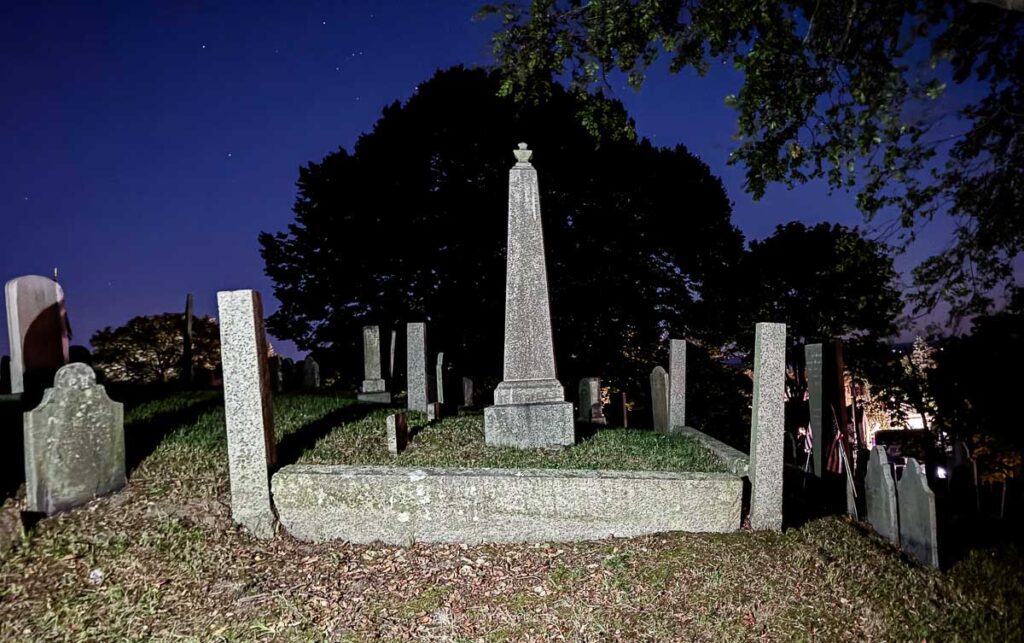
Then we climbed.
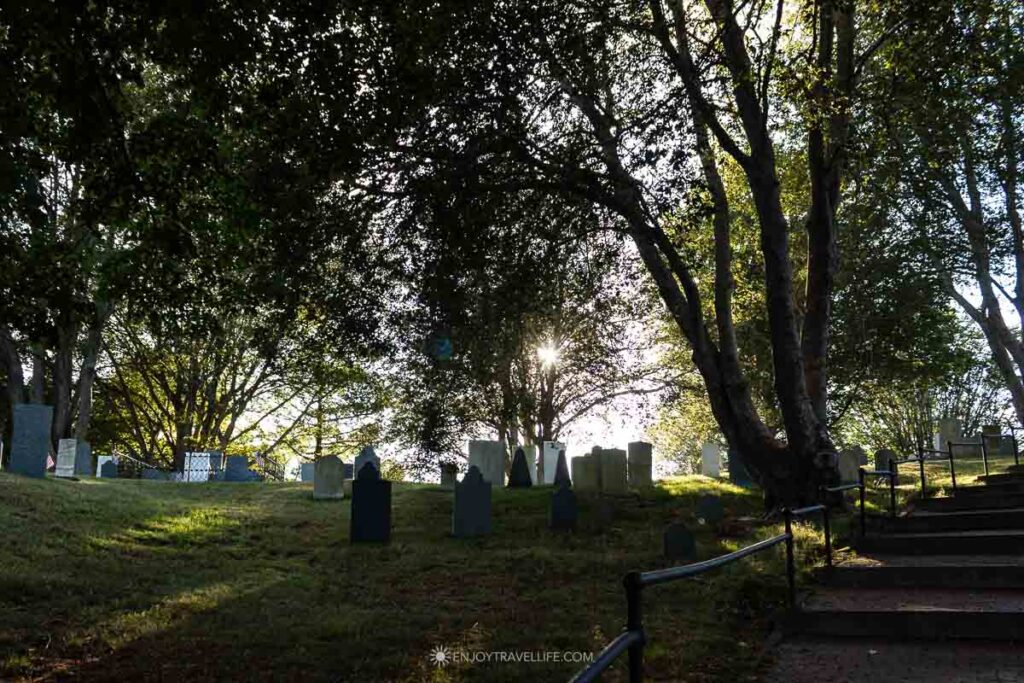
Burial Hill is above Town Square, and the route to the heart of the cemetery means climbing many stairs. I’m not what anyone would call active, and it was a trek, but also completely manageable.
You’ll find a handrail and places to stop. Lauren offered the option to stay at the gate for anyone who felt it would be too challenging. We all took the steps.
I’ve spent time in a lot of cemeteries. I’ve gone for the stone rubbings, to visit people I’ve lost, and to hunt for ancestors.
I had never walked through one at night. And it’s truly creepy.
What I hadn’t expected was to understand something more about Plymouth.
The original settlement spread inland from the harbor along Leyden Street, and the hill at the top was called Fort Hill long before it was a burying ground.
The colonists built their fort and meetinghouse there in 1622.
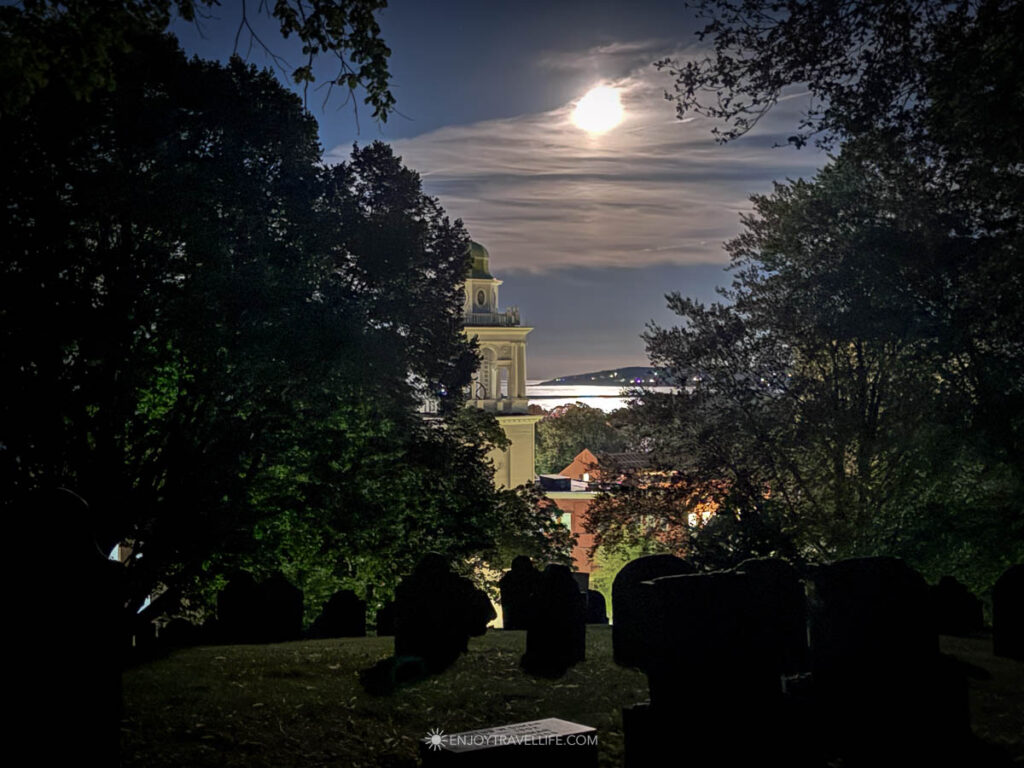
Standing at the top and looking back down at the water, you can see why they chose it. The whole bay is below you.
I’ve lived in Massachusetts my entire life and been to Plymouth more times than I can count. I had never understood how the town was laid out, or why, until I walked up that hill.
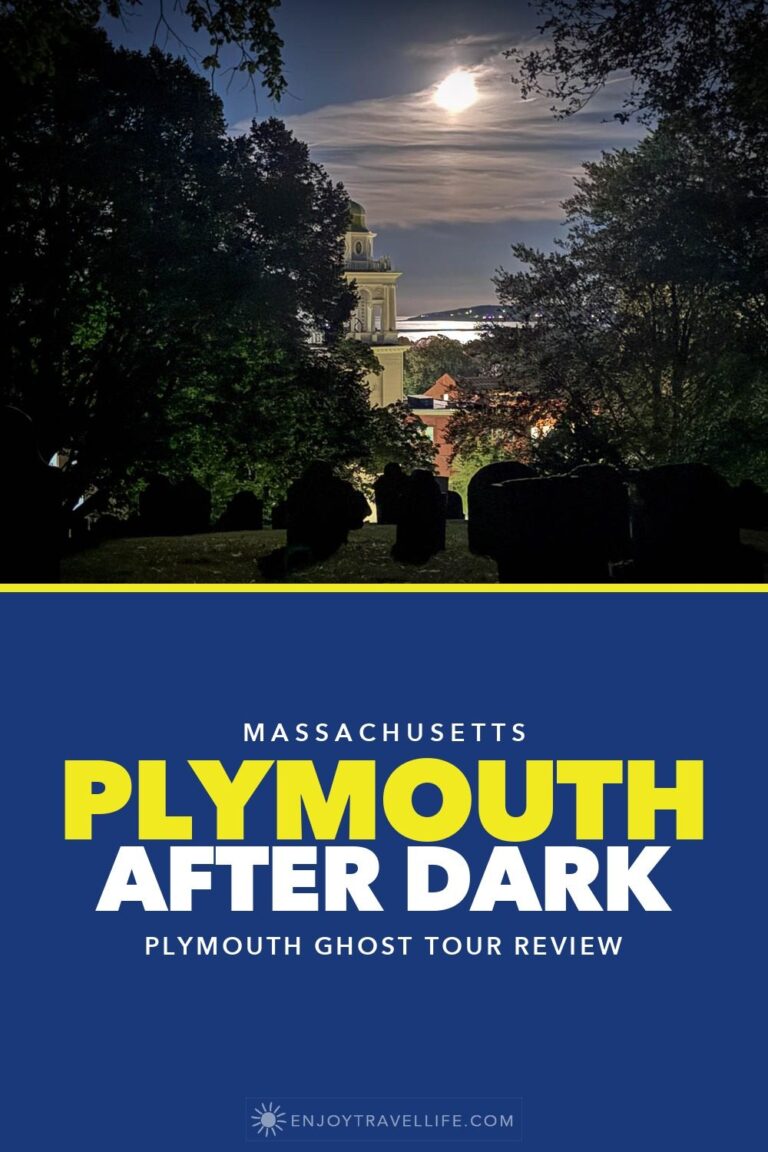
Save this article to Pinterest for later.


Burial Hill is large, steep, and very dark at night. The oldest markers are still legible if you get close.
Some of the thin slate stones have been set into granite to keep them upright, and Governor William Bradford’s memorial stands near the top. He was one of the Mayflower Pilgrims and a leader of Plymouth Colony.
The hill is normally closed from dusk to dawn, so walking through it at night is an unusual part of the tour.
The person least troubled by any of it was the six-year-old.
She knelt beside a grave with the lantern, her face aglow, and started chatting. She ran her finger along the inscription and pretend-read it aloud. Her family read out the real words. Yes, she said, matter-of-factly. That was Mary.
We all felt it at once. Not because anything happened, but because a small child was entirely at home in a place the rest of us were being careful in.
There are plenty of Marys buried on Burial Hill, so I don’t know whose name she was tracing. But one of them is Mary Allerton Cushman (1616–1699), who arrived on the Mayflower as a child and lived to become its last surviving passenger. Her 1699 gravestone is one of only five surviving stones on Burial Hill with a 17th-century date.
Were we at Mary’s grave? I have no idea. But on a ghost tour, it’s the kind of coincidence your mind turns over.
My meter went off again while we waited near the brick steps for the rest of the group to catch up. This time there was no electrical meter six feet away, and Lauren didn’t offer an explanation.
Maybe there’s an electrical line running under those steps.
Maybe someone is buried beneath them and had an opinion about us standing there.
Either way, I enjoyed not knowing more than I would have enjoyed being told.
Is It Actually Scary?
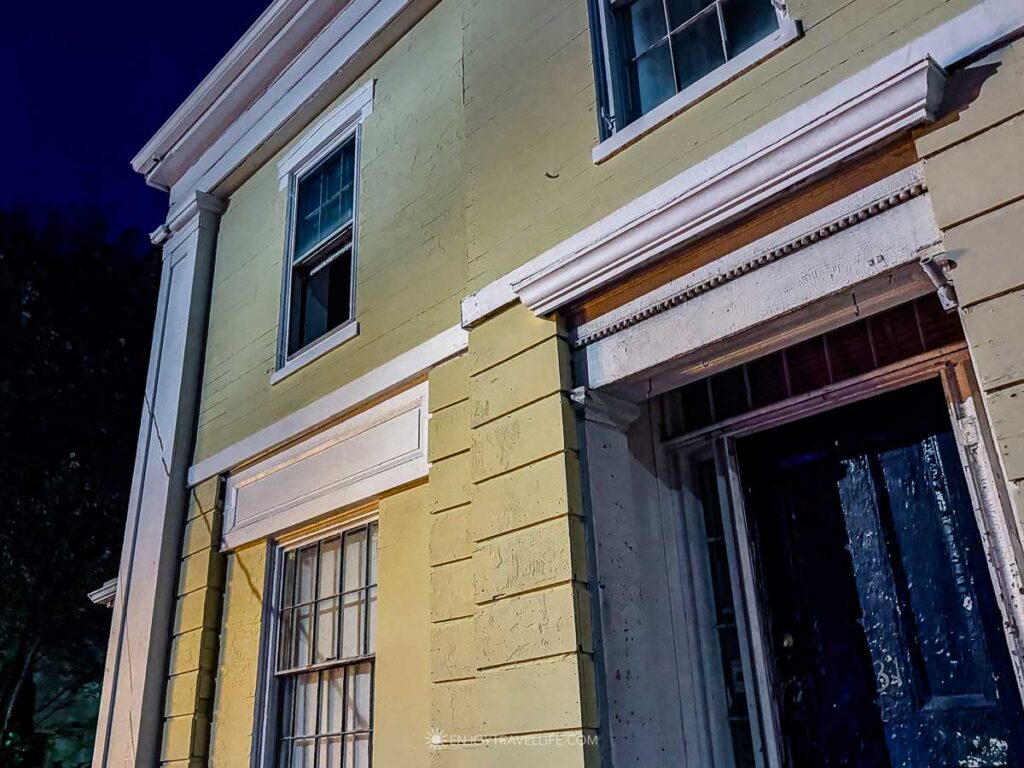
To be completely honest, I went on this tour feeling a little apprehensive. The name of the tour is a bit macabre, and I wasn’t sure what I’d signed up for.
What I got was atmospheric rather than frightening.
There are no jump scares, actors, or anyone leaping out of a doorway. You’re walking through a real town in the dark, hearing stories about people who lived and died there.
That doesn’t mean you won’t get spooked. The setting does some of that on its own. Then there’s the EMF meter, which sometimes has an obvious explanation and sometimes doesn’t.
How scary you find it will probably depend on how much you believe in ghosts and what your imagination does with the stories afterward.
It’s also family-friendly.
A six-year-old did our entire route, and Lauren was careful about what she said within earshot. If you’re bringing children, expect ghost stories and some darker history, not a haunted-house experience.
Is the Extended Tour & EMF Detector Worth It?
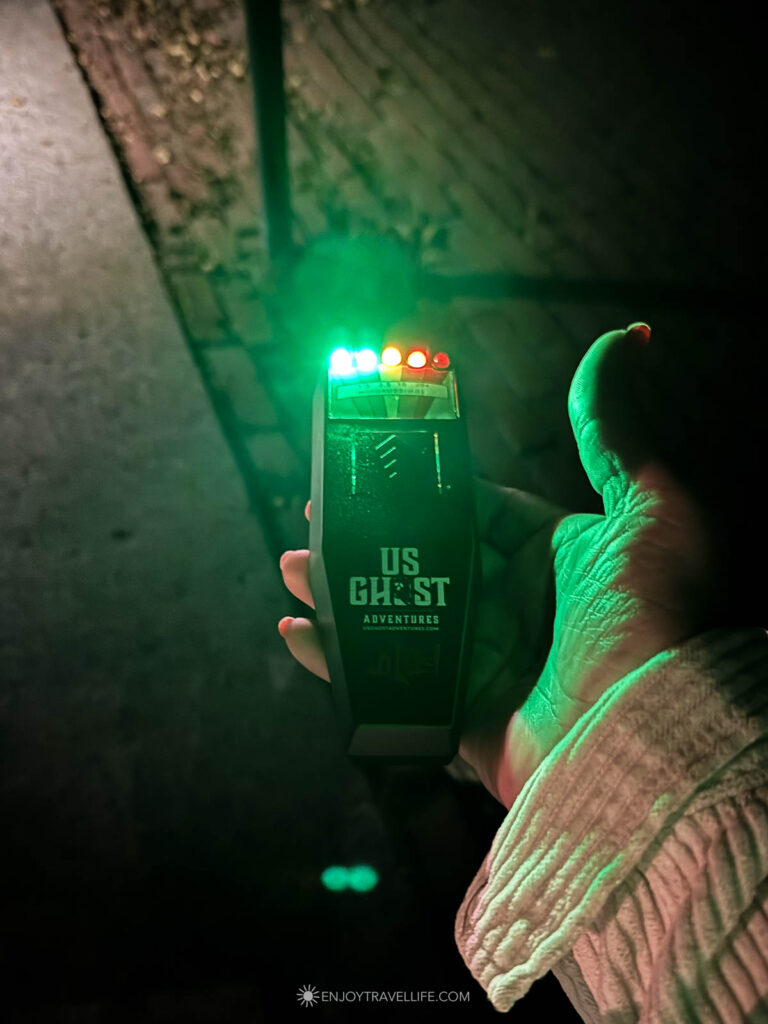
I signed up for the extended tour, and I’m glad I did. It adds up to four more stops and more time with the guide. The history also gets broader and, in places, considerably darker.
My tour was hosted, so I can’t tell you the upgrade felt like money well spent out of my own pocket. But I can tell you what it adds and what it costs.
At the retail price on my booking, the extension was $7 per person. The EMF detector was another $7.
For one or two people, I’d add the extension. It’s a small increase for more time and several additional stops. For a family paying per person, the difference adds up, so I’d consider how much longer you want to be out before booking the upgrade.
The EMF meter is more optional. I had fun with it, but you don’t need one to enjoy the tour. For the extra few bucks, it adds another layer of mystery.
Plymouth’s Ghost Tours, Compared
I haven’t taken the other three tours listed below, but they offer some different ways to explore haunted Plymouth. The Haunted Harbor Tour gets you off your feet, the Plymouth Night Tour puts equipment in everyone’s hands, and Dead of Night offers a locally run alternative.
The tour I’ve described above is the lantern-led Punishment, Penance, and Plague tour. That’s the one I recommend.
| Tour | Format | Length | Price | Booking |
|---|---|---|---|---|
| Punishment, Penance, & Plague | Lantern walking tour | 1 hour standard; extension adds up to 4 stops | $26 adult, (Optional: extended tour +$7, EMF detector +$7) | Book online Discount code: ENJOY10 for 10% off |
| Dead of Night Twilight Lantern | Lantern walking tour | 2 hours | $25 adult, $15 child under 10 | Book online or call 508-277-2371 |
| Haunted Harbor Tour | Narrated boat cruise | 75 minutes | From about $41 booked direct | Book online |
| Plymouth Night Tour | Walking tour, equipment included | 2 hours | $30 adult | Book online |
What to Know Before You Go
A few tips will make your Plymouth ghost tour experience go more smoothly.
Visit Burial Hill during the day if you want to more fully explore the site of the original fort, see the replica cannon, and get a closer look at the historic graves. You won’t be able to see nearly as much during the nighttime tour.
- Arrive fifteen minutes early. Check-in is at the meeting point, and your confirmation will give you the details.
- Wear comfortable shoes and bring a layer. You’ll be walking and standing outdoors, and it can get cool along the waterfront after sunset.
- Bring a small bag. Even though I travel light, by the end, I was juggling a camera, water, phone, jacket, and EMF meter. A small backpack or crossbody would have helped.
- Be prepared for stairs. You’ll climb steps from the Plymouth Rock portico up toward town, followed by a longer climb into Burial Hill. Both have handrails and places to stop. Our guide offered the option to wait at the Burial Hill gate for anyone who couldn’t manage the climb.
- Expect to stay outdoors. You won’t enter the historic houses or other buildings along the route.
- Think about where you park. Plymouth has plenty of public parking, including metered street spaces and lots along Water Street. Most paid parking is $2 per hour and becomes free after 7 p.m., so I only paid a few dollars for the evening. One thing I didn’t consider: the tour starts at Plymouth Rock but ends closer to Burial Hill and the John Carver Inn. If you don’t want to creep yourself out walking back to your car after a ghost tour, consider parking closer to where you’ll finish.
- Come to Plymouth early. The waterfront is worth some time before check-in. For more ideas, see my things to do in Plymouth article.
- Visit Burial Hill during the day, too. It’s free and normally open from dawn to dusk. Pilgrim Hall Museum and the Plymouth Antiquarian Society also jointly offer free daytime tours on select dates.
- Use the restroom before the tour. You’ll find clean public restrooms at Pilgrim Memorial State Park near Mayflower II. They’re open until 8 p.m. during the summer, which gives you time to stop before the tour begins. There are no restroom stops once you’re underway.


Final Thoughts on the Plymouth Ghost Tour
I expected to come home with an answer about how frightening the tour was. That turned out to be the less interesting question.
I came away knowing more about Plymouth than I did when I arrived. The ghosts are the thread through four centuries of people and history. There are colonists who settled here, sea captains and their widows, families whose names are still on the streets, and ordinary people whose stories might otherwise be forgotten.
If you enjoy local history with a little mystery thrown in, a Plymouth ghost tour is a fun way to spend an evening. Go for the history. Let the dark do what it does. How spooky it gets from there is up to you.
US Ghost Adventures hosted my tour as part of a media visit. As always, all opinions are my own.
FAQs
Where does the Plymouth ghost tour start?
Punishment, Penance, and Plague meets at Plymouth Rock, 79 Water Street, in Pilgrim Memorial State Park. Check-in opens fifteen minutes before the 8 p.m. start, and your guide will be the one holding a lantern. Dead of Night’s twilight tour also meets on Water Street at the Rock. The Plymouth Night Tour starts from 65 Main Street, and the Haunted Harbor cruise leaves from 9 Town Wharf.
How long is the Plymouth ghost tour?
The standard Punishment, Penance, and Plague route is an hour and covers about a mile on foot. The extended version adds up to four more locations. Elsewhere in town, the Haunted Harbor cruise runs 75 minutes, and both Dead of Night’s twilight tour and the Plymouth Night Tour run two hours.
Can you visit Burial Hill at night without a tour?
Not in the ordinary way. Plymouth’s town cemeteries are generally open dawn to dusk, and the town has an approval process for tours and events on the hill. Evening ghost tours operate there after normal public hours. During the day Burial Hill is free and open, and Pilgrim Hall Museum and the Plymouth Antiquarian Society run free guided tours on the first Saturday of most months.
Do you need to book a Plymouth ghost tour ahead?
It depends on the operator. Punishment, Penance, and Plague and the Plymouth Night Tour both book online. Dead of Night books online or by phone on 508-277-2371 or 508-866-5111. Booking early is worth it in October, when Plymouth’s spooky season is at its busiest.
Is the Plymouth ghost tour OK for kids?
On my tour a six-year-old completed the whole route, and our guide was careful about what she said within earshot. It’s a walking tour rather than a haunted attraction, so there are no actors and no jump scares. Bear in mind that it’s entirely outdoors and that reaching Burial Hill means a climb over steps.

Next Steps
For more New England after-dark trips, read these articles next: